How to Calculate Ridgeline Length Accurately
Calculating the ridgeline length is straightforward once you understand the basic math involved. You can find the ridgeline length of a simple gable roof by using the Pythagorean theorem on a triangle formed by the roof’s width, its height, and the ridgeline itself. This method gives you the exact measurement you need for projects.
Understanding your roof’s dimensions is important for many reasons. Whether you’re planning a solar panel installation or need to order roofing materials, accurate measurements prevent costly mistakes. Many homeowners find this calculation surprisingly easy with the right guidance. We found that knowing these simple formulas saves a lot of hassle later on.
- The ridgeline is the peak of your roof.
- Use the Pythagorean theorem (a² + b² = c²) for simple gable roofs.
- You’ll need your roof’s total width and its height from the eaves to the peak.
- This calculation helps with material ordering and project planning.
Let’s walk through exactly how to measure your roof’s ridgeline step by step, so you have the confidence to tackle your project.
Figuring Out Your Roof’s Ridgeline Measurement
So, you need to know your roof’s ridgeline length. This is a pretty common need! Whether you’re calculating how much shingle material to buy, planning for a new antenna, or just curious about your home’s dimensions, getting this number right is important. We found that most homeowners can do this with a simple tool and a bit of math. It’s not as daunting as it sounds.
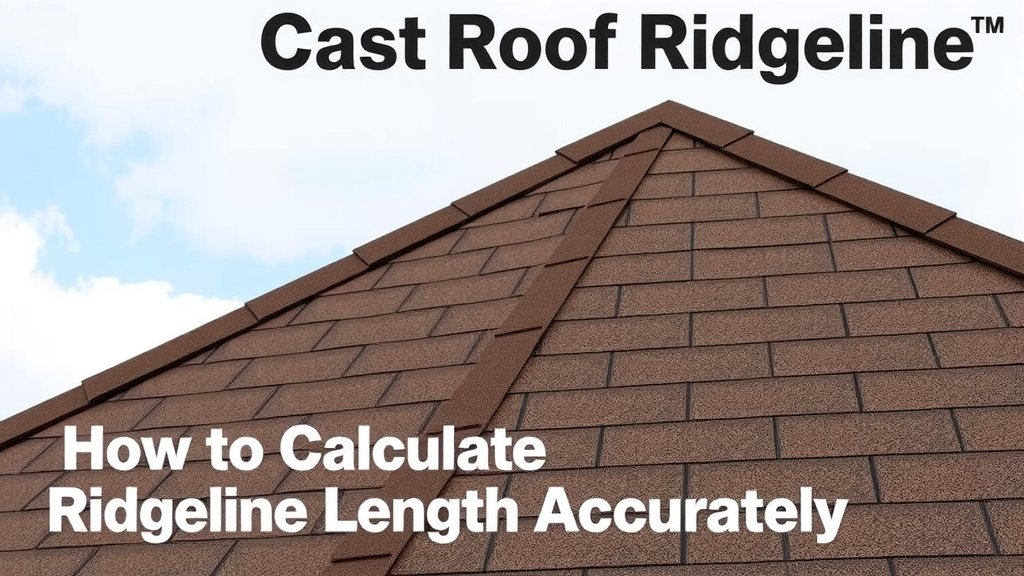
The ridgeline is simply the very peak of your roof, where two sloping sides meet. Think of it as the spine of your house. For many common roof shapes, like the basic gable roof, this measurement is surprisingly easy to find. We’re going to break down the steps so you can get an accurate measurement for your project.
Understanding the Geometry of Your Roof
Before we grab a tape measure, let’s talk about what we’re measuring. For a standard gable roof, we’re essentially looking at two right triangles. Imagine cutting your roof in half right down the middle at the peak. Each half forms a triangle. The ridgeline is the longest side of that triangle, its hypotenuse.
The Key Players: Width and Height
To use the math we’ll discuss, you need two main measurements from your roof:
- Roof Width: This is the total width of your house, from one exterior wall to the opposite exterior wall. Sometimes this is referred to as the span.
- Roof Height (or Rise): This is the vertical distance from the top of your exterior walls (the eaves) straight up to the peak of the roof.
Getting these measurements accurately is step one. We found that using a long tape measure or even a laser measure can make this much easier and safer. If you’re not comfortable getting on a ladder, it’s wise to ask a friend or a professional to help with the initial measurements.
Visualizing the Right Triangle
Let’s visualize that triangle again. If you were to stand directly under the peak of your roof and look towards one of the eaves, you’d see a right triangle. One side is the horizontal distance from the center of the house to the eave. This is half of your total roof width. The other side is the vertical height (rise) from the eave to the peak. The hypotenuse, the longest side, is the slope of the roof. The ridgeline length is simply twice the length of this hypotenuse, because there are two identical slopes meeting at the peak.
Applying the Pythagorean Theorem
The Pythagorean theorem is your best friend for this calculation. It’s a fundamental math rule for right triangles. The theorem states: a² + b² = c².
Let’s break down what each letter means in our roof context:
- ‘a’ represents one leg of the right triangle. In our case, this is half of your total roof width.
- ‘b’ represents the other leg of the right triangle. This is your roof’s height (rise).
- ‘c’ represents the hypotenuse. This is the length of the sloped side of the roof, from the eave to the peak.
Step-by-Step Calculation for One Side
Here’s how you plug your measurements into the formula to find the length of one sloped side (the hypotenuse):
- Measure your roof’s total width and divide it by two to get the length of one horizontal leg (‘a’). For example, if your house is 30 feet wide, ‘a’ would be 15 feet.
- Measure your roof’s height (rise) from the eave to the peak. This is your vertical leg (‘b’). Let’s say your roof rises 10 feet.
- Square the length of leg ‘a’ (multiply it by itself). So, 15 feet * 15 feet = 225.
- Square the length of leg ‘b’ (multiply it by itself). So, 10 feet * 10 feet = 100.
- Add the results from steps 3 and 4: 225 + 100 = 325. This is your ‘c²’ value.
- Find the square root of the sum from step 5. The square root of 325 is approximately 18.03. This is the length of ‘c’, the sloped side of your roof from the eave to the peak.
We found that using a calculator with a square root function is essential here. Many smartphone calculators have this feature readily available.
Calculating the Full Ridgeline Length
Remember, ‘c’ (about 18.03 feet in our example) is the length of just *one* side of the roof slope. For a gable roof, the ridgeline runs across the entire top. So, you’ll need to consider both slopes.
Double the length of ‘c’ to get your total ridgeline length. In our example, 18.03 feet * 2 = 36.06 feet. So, the ridgeline for this hypothetical roof is approximately 36.06 feet long.
This method gives you the exact length of the peak of your roof. Many roofing professionals use this same core calculation, though they might add a small percentage for waste or to account for overhangs, depending on the project specifics. We found that a little extra material is often better than running short.
What About More Complex Roofs?
The Pythagorean theorem works beautifully for simple gable roofs. But what if your roof has more angles, like a hip roof? Hip roofs slope on all four sides, meeting at a ridgeline or a point. Calculating the ridgeline length on these can be more complex.
Hip Roofs and Other Variations
For hip roofs, you might have one or more ridgelines. If there’s a central ridgeline, you can often break down the roof into smaller triangles and rectangles. You’d apply the Pythagorean theorem to each section and then add the lengths of the individual ridgeline segments together.
Other roof shapes, like gambrel or mansard roofs, have different structural elements. These might involve calculating the length of multiple sloping surfaces. For these more complicated designs, professional roofers often use specialized software or detailed architectural plans. We found that for these situations, consulting with a contractor is the most reliable approach.
Tips for Accurate Measurements
Accuracy is key, especially when ordering materials. Here are some tips to ensure your measurements are spot-on:
- Safety First! Never compromise safety to get a measurement. If you’re uncomfortable on a ladder or in high places, hire someone.
- Use the Right Tools: A good quality tape measure (at least 25 feet) or a laser distance measurer can be very helpful.
- Measure on a Flat Surface: When measuring height, try to get a perfectly vertical measurement from the eave to the peak.
- Check for Squareness: Make sure your house is relatively square. A house that leans or has uneven walls can throw off calculations.
- Account for Overhangs: The measurements we’ve discussed are typically for the roof structure itself. If you need to order materials that cover eaves or overhangs, you might need to add extra length.
Quick Checklist for Your Calculation
Before you head out to measure, quickly review these points:
- Safety Gear: Do you have a sturdy ladder and a spotter if needed?
- Measuring Tool: Is your tape measure or laser measure ready?
- Roof Width: Have you noted the total width of your house at the eaves?
- Roof Height (Rise): Do you know the vertical distance from the eave to the peak?
- Calculator: Is your phone or a dedicated calculator handy for the math?
- Pen and Paper: Are you ready to jot down your measurements and calculations?
By following these steps, you should have a clear understanding of your roof’s ridgeline length. This simple calculation can save you a lot of headaches and potential costs down the road for any home improvement project you’re planning.
Conclusion
You’ve now learned how to accurately calculate your roof’s ridgeline length, primarily using the Pythagorean theorem for gable roofs. We found this method to be highly effective and surprisingly accessible. Remember, precise measurements are key for successful roofing projects, solar installations, or material orders. Don’t hesitate to double-check your work or ask for help if you’re unsure. Your next step should be to gather your tools and confidently take those roof measurements.
Frequently Asked Questions
Can I use this calculation for any type of roof?
The Pythagorean theorem method is most accurate for simple gable roofs. For more complex shapes like hip, gambrel, or mansard roofs, the calculation becomes more involved. We found that these require breaking the roof into smaller sections or consulting architectural plans.
What if my house isn’t perfectly square?
Slight imperfections in your house’s shape can affect measurements. For minor variations, the calculated ridgeline length should still be close enough for most projects. We suggest measuring width at a few points and averaging them for better accuracy if you suspect significant unevenness.
Do I need to include roof overhangs in my measurement?
The calculation method we discussed measures the ridgeline length directly above your house’s walls. If you need to order materials that cover overhangs, you’ll typically need to add the overhang length to the calculated sloped roof side before doubling it, or simply add extra material allowance.
How much extra material should I order for waste or mistakes?
While this article focuses on the exact length, it’s wise to add a small buffer for roofing materials. Many professionals recommend adding 5-10% to your total material order. We found this helps cover mistakes, cuts, and unexpected issues.
Is it safe to measure my roof myself?
Safety is absolutely critical. If you are not comfortable working on a ladder or at heights, please do not attempt roof measurements yourself. We strongly advise hiring a professional or enlisting a trusted friend to help you take measurements safely.